

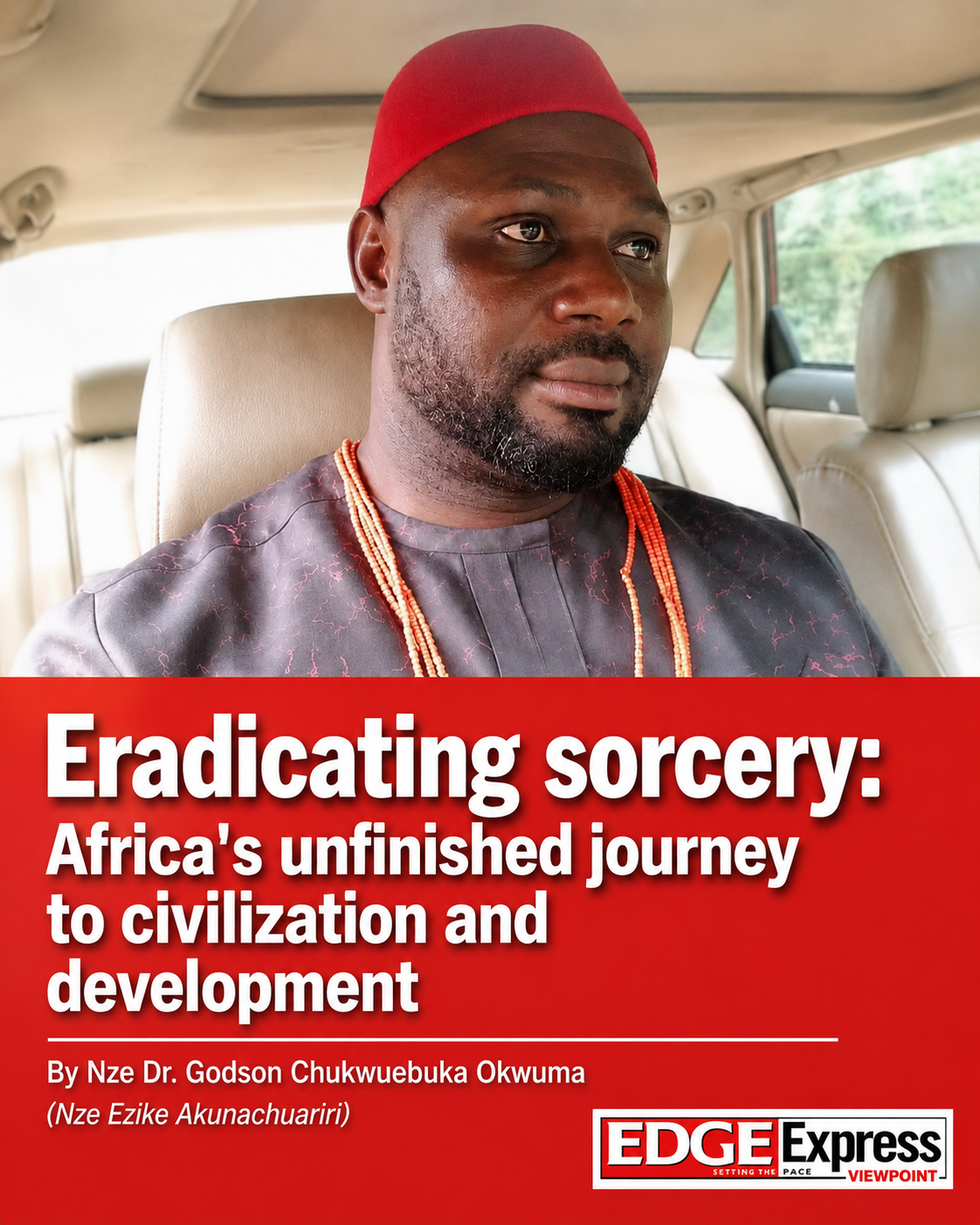
By Nze Dr. Godson Chukwuebuka Okwuma (Nze Ezike Akunachuariri 1)
One of the greatest obstacles to Africa’s development is not a lack of natural resources, intellectual capacity, or entrepreneurial talent. Rather, it is the continued influence of beliefs and practices that keep millions trapped in fear, superstition, and irrationality. Among these is the enduring belief in sorcery and the enormous social, economic, and political consequences that flow from it.
This position may sound controversial in societies where belief in supernatural manipulation has become deeply embedded in culture, religion, and everyday life. Yet history teaches us that no society has achieved genuine civilization and sustainable development while allowing fear of sorcery to dominate public thinking.
Britain and many Western countries offer important lessons. Several centuries ago, Europe was not very different from present-day Africa in its attitude toward witchcraft and supernatural claims. People blamed mysterious illnesses, failed harvests, economic hardships, and even political crises on witches and sorcerers. Thousands were accused, tried, imprisoned, and executed.
However, the rise of science, education, and the Enlightenment transformed European societies. Rational inquiry replaced superstition. Evidence replaced speculation. Scientific explanations replaced supernatural accusations. Governments increasingly relied on law, research, and reason rather than fear and magical thinking. The result was the Industrial Revolution, technological advancement, economic growth, and the emergence of modern democratic institutions.
Africa must learn from this historical experience.
Today, many Africans still explain poverty, business failure, infertility, sickness, accidents, and even death through the lens of sorcery. Rather than investigating practical causes, attention is often diverted toward spiritual enemies and alleged supernatural attacks. Such thinking discourages critical analysis and promotes dependency on individuals who claim special powers to identify, combat, or neutralize unseen forces.
The consequences are devastating.

Families have been torn apart by accusations of witchcraft. Marriages have collapsed because of prophecies declaring one spouse responsible for the misfortunes of another. Children have been abandoned after being branded as witches. Elderly women have suffered humiliation, violence, and social exclusion because they were suspected of possessing supernatural powers.
In Nigeria, the situation has become particularly troubling. The increasing commercialization of prophecy in some religious circles has created a culture in which unverifiable spiritual declarations often carry more weight than evidence and common sense. Relationships have broken down because of prophecies accusing relatives, friends, or spouses of being agents of darkness. Businesses have failed because owners relied more on prophetic assurances than on sound management principles. Communities have been divided by spiritual allegations that could never be substantiated.
Traditional practitioners have also contributed to the problem. In many instances, individuals seeking explanations for life’s challenges are encouraged to believe that unseen enemies are responsible for every setback. Such narratives may provide emotional comfort, but they rarely provide practical solutions. Instead, they reinforce fear, suspicion, and dependency.
Even politics has not escaped the influence of superstition.
Election seasons often witness increased consultations with prophets, seers, and traditional spiritualists. Political actors spend enormous resources seeking supernatural advantage rather than developing credible policies and governance strategies. Political decisions influenced by mystical predictions rather than evidence-based analysis cannot produce sustainable development.
The tragedy is that while advanced nations invest in research laboratories, technological innovation, artificial intelligence, and scientific education, many African societies continue to expend significant energy debating witches, sorcerers, curses, and prophetic revelations.
No nation can compete effectively in the twenty-first century while remaining intellectually captive to ideas that belong to a pre-scientific age.
This does not mean that Africans should abandon faith or spirituality. Religious belief can provide moral guidance, social cohesion, and personal inspiration. However, faith should never become a substitute for reason, evidence, education, and accountability. A civilized society distinguishes between personal belief and public decision-making.
The future of Africa depends on cultivating a generation that values scientific inquiry, critical thinking, technological innovation, and evidence-based solutions. Schools must teach students how to question assumptions and evaluate claims objectively. Governments must strengthen institutions that protect citizens from harmful accusations and exploitation. Religious and traditional leaders must promote responsibility and discourage teachings that foster fear and division.
The path followed by Britain and other developed nations was not easy. They had to overcome centuries of superstition and irrational beliefs before embracing modernity. Africa faces a similar challenge today.
If the continent is serious about civilization and development, it must confront the culture of sorcery, witchcraft accusations, and unverified supernatural claims that continue to hold back social progress. The Africa of the future must be built not on fear of unseen enemies but on knowledge, innovation, justice, and reason.
Only then can the continent fully realize its immense potential and take its rightful place among the world’s most advanced societies.