
By Chimezie Ezeji
Private school proprietors in Imo State, under the aegis of the National Association of Proprietors of Private Schools (NAPPS), Imo State Chapter, have rejected several policies and directives issued by the Ministry of Primary and Secondary Education, describing them as anti-private school, anti-parent and harmful to the state’s economy.
The proprietors, in a formal objection dated September 3, 2026 and addressed to the Commissioner for Primary and Secondary Education, Prof. Bernard-Thompson O. Ikegwuoha, said some of the policies contained in the Ministry’s 22-point agenda discussed on August 27 and its seven-point public announcement of August 30 amounted to undue interference in private education.
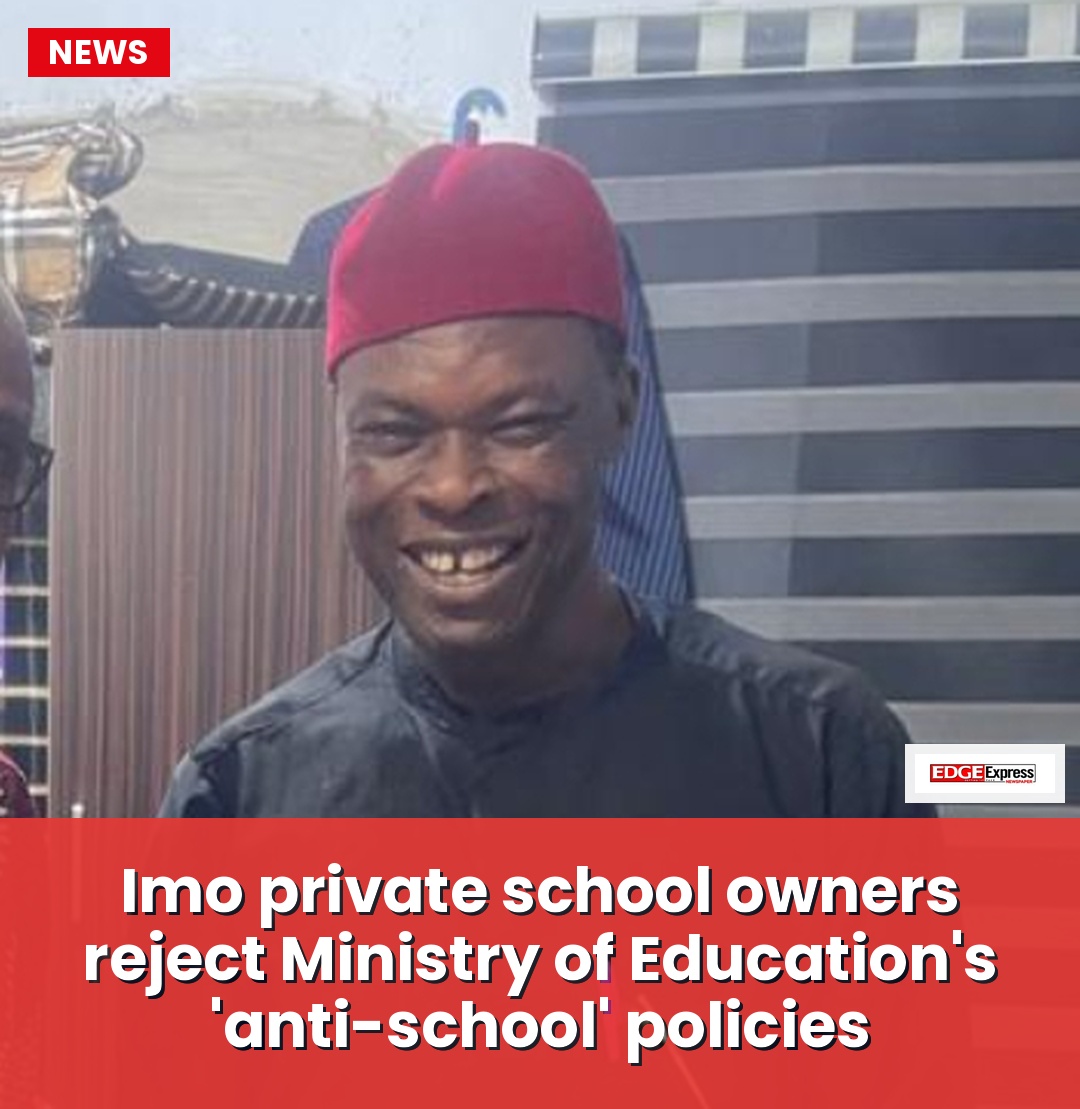
The letter, signed by the NAPPS Imo State President, Hon. Chief Theo Mbakwe, and State Secretary, Mr. Answer Ukwuoma, acknowledged the Ministry’s commitment to improving the quality of education but insisted that private schools remained independent businesses with rights that must be respected.
NAPPS said it accepted some of the Ministry’s directives in the spirit of partnership, including the uniform resumption date of September 14, 2026, release of Common Entrance and BECE results, issuance of detailed receipts, mandatory approval and renewal of school licences, as well as adherence to basic school opening and closing hours.
However, the association strongly rejected what it described as policies that would undermine private school operations and increase the financial burden on parents.
One of the major areas of disagreement is the directive that admission into JSS1 should be based solely on the government placement test.
According to NAPPS, private schools are not extensions of government schools and should retain the right to determine their admission standards.

The proprietors argued that the placement card does not provide parents with the option of choosing private schools, despite the fact that many parents whose children would never attend public schools were compelled to pay for the examination.
The association described the arrangement as extortionate and said it infringed on parents’ freedom of choice.
NAPPS also kicked against the ban on the collection of admission consumables such as toilet rolls, arguing that such items are directly used by pupils and students and help reduce the financial burden on parents.
The proprietors warned that banning such consumables without providing alternatives would force schools to increase tuition fees by between 15 and 20 per cent.
They also described the threat to revoke school licences over the issue as draconian and disproportionate.
Another major point of contention is the Ministry’s directive suspending textbook sales and its move to establish a committee to determine textbook prices.
NAPPS argued that imposing prices on textbooks amounted to price control and could create a monopoly, while also disrupting teaching and learning as schools prepare for resumption.
The association further warned that the policy could negatively affect booksellers and publishers operating in Imo State, many of whom, it noted, are also parents with children in public and private schools.
It also distanced itself from the textbook committee, alleging that the committee was not properly constituted and was not given an opportunity to submit its report before the Ministry announced its decision.
The proprietors equally rejected what they described as the proposed takeover of Parent-Teacher Association (PTA) affairs in private schools.
NAPPS objected to the directive that PTA levies should be determined by two parents and one teacher, with proprietors allegedly losing the authority to determine how the funds are spent.
According to the association, private school proprietors bear the full risks of running their businesses, including loans, salaries, rents and other operational costs.
It maintained that while PTA should remain advisory, it should not be transformed into a management structure capable of controlling private school investments.
The association also opposed the proposed uniformity of WAEC and NECO fees for public and private schools.
NAPPS said private schools incur costs associated with CBT training, practical examinations and other logistics without government subvention, making a uniform fee structure unrealistic.
It warned that the policy could force private schools either to operate at a loss and compromise examination preparations or introduce other charges to remain financially viable.
Instead, the proprietors called for transparency through proper itemisation of examination-related charges so that parents would know what they are paying for.
On school fees, NAPPS rejected what it described as an attempt at indirect price fixing through a directive that fees should be “commensurate” with the quality of services provided.
The association said tuition fees reflect several factors, including location, diesel and energy costs, staff quality and loan repayments, stressing that private schools receive no government subsidy.
The proprietors also raised concerns over what they called an unrealistic documentation and taxation deadline running from August to November 2026.
NAPPS said requiring schools to obtain documents such as Certificates of Occupancy, OCDA Integrity Test certificates, CAC incorporation documents, FIRS Tax Identification Numbers, three-year tax clearance certificates, staff birth certificates and local government certificates of origin within three months was impracticable.
According to the association, some of the required documents could take between six and 12 months to obtain.
It warned that deregistration over failure to meet the deadline could wipe out more than 70 per cent of low-cost private schools and leave thousands of teachers without jobs by December.
NAPPS also objected to the deadline for boarding school re-certification and the compulsory provision of ICT laboratories and e-libraries by December 2026.
While acknowledging the importance of ICT facilities, the association argued that imposing the requirement on all schools without considering differences in electricity supply and network coverage would disproportionately affect rural schools.
It warned that the policy could force rural parents to spend more than 300 per cent extra to send their children to schools in Owerri and other urban areas.
The proprietors further criticised the directive that all correspondence from private schools should be addressed directly to the Commissioner, bypassing the Permanent Secretary and Directors.
NAPPS described the arrangement as anti-bureaucratic, warning that it could create unnecessary delays and encourage sycophancy within the system.
The association also condemned the ₦30,000 charge per centre imposed on private schools for the placement test, BECE and other examinations after the schools had already registered their pupils and students for the 2025/2026 examination year.
NAPPS described the charge as “total extortion” and called for an end to the practice.
The proprietors consequently called for the immediate suspension of the punitive timelines attached to the documentation, boarding re-certification, ICT laboratory and e-library requirements.
They also demanded the withdrawal of the directives relating to PTA control, textbook price fixing and uniform examination fees for private schools.
Most importantly, NAPPS called for sustained dialogue between the Ministry and the recognised leadership of the association under Chief Theo Mbakwe.
The association urged the Commissioner to engage the recognised NAPPS leadership, which it said he had publicly affirmed following a reconciliatory meeting, rather than dealing with what it described as breakaway groups.
NAPPS stressed that private schools remain partners in the development of education in Imo State and should be supported through constructive engagement rather than policies capable of strangulating their operations.
The association said it remained committed to improving educational standards and working with the government, but insisted that such partnership must respect the rights of private school owners, protect parents from unnecessary financial burdens and ensure the survival of the private education sector.