
By Jennifer John
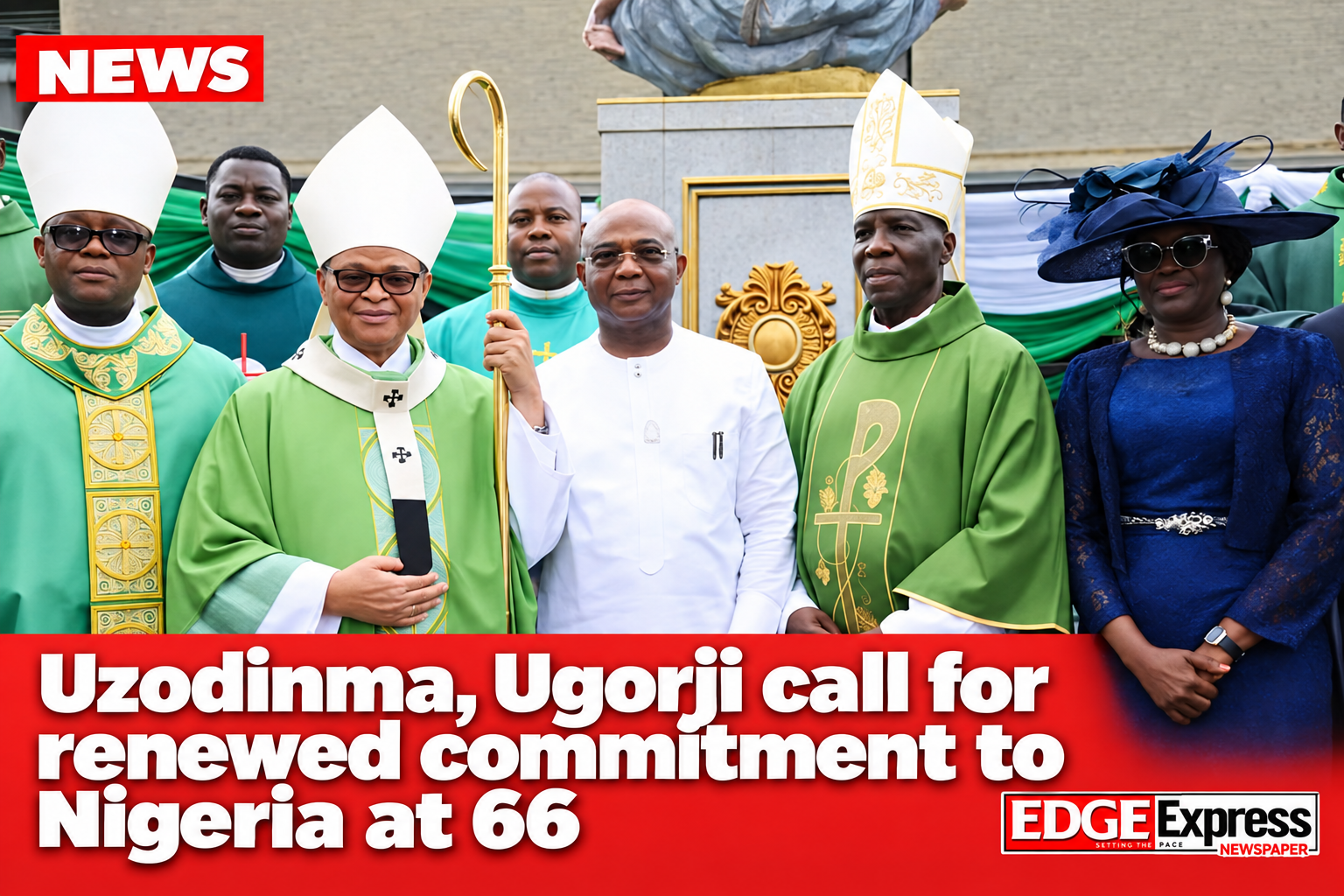
Imo State Governor, Senator Hope Uzodimma, and the Archbishop of Owerri Archdiocese, Most Rev. Lucius Iwejuru Ugorji, have called on Nigerians to renew their commitment to nation-building, stressing that the challenges confronting the country require responsible leadership, integrity and active citizenship.
They made the call during a Thanksgiving Service held at the Assumpta Cathedral, Owerri, to mark Nigeria’s 66th Independence Anniversary.
Reflecting on Nigeria’s journey since independence in 1960,
Uzodinma said the country had passed through the Civil War, military rule, economic difficulties and political crises, yet had remained united.
The governor said Nigeria’s survival as one country after 66 years was a reason for thanksgiving to God, noting that generations of Nigerians had made sacrifices to preserve the unity of the nation.
He, however, acknowledged that Nigerians were still facing difficult economic conditions, stressing that government must ensure that the sacrifices being made by citizens translate into meaningful improvements in their lives.
According to him, economic progress becomes meaningful when ordinary Nigerians can feel its impact in their daily lives.

Uzodinma said he remained confident that Nigeria would sooner rather than later arrive at its desired destination, but urged citizens to also examine their individual responsibilities in building the country.
He said leadership should not be viewed as something that begins and ends in Government Houses or at Aso Rock, insisting that leadership begins in families, communities, churches, schools, markets and workplaces.
The governor said Nigerians could not continue to demand accountability from government while tolerating dishonesty and indiscipline in their personal lives.
He cited the dumping of refuse in drainage channels and subsequent complaints about flooding, violation of traffic rules, cheating in business and celebration of wealth acquired through fraud as examples of behaviours that undermine the society.
Uzodinma stressed that public officials had a greater responsibility because they were entrusted with public authority, but added that those in government were products of the same society.
“Before somebody becomes a governor, or a minister, or a legislator, or a local government chairman, that person has already spent many years learning from the society around him,” he said.
He urged Nigerians to cultivate honesty, fairness and responsibility in their various spheres of influence, calling on employers to pay workers fairly, traders to deal honestly with customers and leaders of associations to manage entrusted resources with integrity.

He said such actions might appear insignificant compared with decisions taken by presidents and governors, but were important because they shaped the values and habits of society.
“If honesty matters to us only when we are talking about government, then we have misunderstood what honesty is,”.
He further declared that Nigeria belonged to all citizens and urged Nigerians to consider the kind of country they were creating through their everyday actions.
Uzodinma also expressed optimism about developments in Imo State, urging residents to compare the state they knew in 2020 with the state today.
“If you remember Imo State of 2020 and compare it with the Imo State of today, you will see that we are moving from darkness to light,” he said.
The governor prayed that God would give those in public office the wisdom and humility to serve the people well, while giving Nigerians the courage to do what was right even when nobody was watching.
In his message, the Archbishop of Owerri Archdiocese, Most Rev. Lucius Ugorji, said Nigeria’s 66th Independence Anniversary should be a moment of thanksgiving, sober reflection and renewed commitment to the ideals upon which the country was founded.
Ugorji recalled that Nigerians at independence in 1960 looked into the future with hope, dreaming of a strong and prosperous nation where freedom, peace and unity would reign.
He noted that Nigeria had recorded significant progress in several sectors over the decades, particularly in education and the expansion of tertiary institutions, while successive governments had introduced economic reforms and other measures aimed at promoting national development.
Despite the progress, however, the Archbishop said Nigeria continued to face serious economic and social challenges, including inflation, unemployment, insecurity, inadequate electricity, corruption and weak institutional accountability.
He said the country’s dependence on crude oil had also left the economy vulnerable to external shocks.
According to him, Nigeria had survived the Civil War, military dictatorship, economic recessions and other national difficulties by the special grace of God.
Ugorji urged Nigerians not to allow the country’s challenges to blind them to its blessings, noting that Nigeria was endowed with abundant natural resources and enormous human capital.
He described Nigerians as resilient, energetic and productive people whose achievements in medicine, academia, technology, sports and the arts had demonstrated the enormous potential of the country.
The Archbishop said Nigeria’s continued existence as one nation after decades of challenges was itself a testimony to the resilience of the people.
“Proverbs 14:34, Righteousness exalts a nation, but sin condemns any Nation,” Ugorji said the biblical injunction should guide the country’s national consciousness.
He explained that righteousness in the national context included good governance, justice, integrity in public office, fairness in the marketplace, truth in communities and respect for the rule of law.
He warned that corruption, injustice and dishonesty weaken the foundations of national development by destroying public trust.
The Archbishop said corruption should not be viewed only as the stealing of public funds by political leaders, but also as everyday acts of dishonesty committed by citizens.
He cited bribery by civil servants, examination malpractice, exploitation of customers, extortion by law enforcement personnel, compromise of justice and manipulation of elections as examples of practices that contribute to moral decay in society.
“If we want a new Nigeria, we must become new Nigerians,” he said, calling for a transformation that would begin in the hearts, homes, businesses and churches of Nigerians.
Ugorji said Nigerians must cultivate honesty, hard work and perseverance and learn to do what was right even when nobody was watching.
The Archbishop also called on Nigerians to reject ethnic and religious divisions, saying the country’s diversity should be a source of strength rather than a tool for division.
He said Nigerians had allowed ethnic identities and religious sentiments to be exploited by some politicians, particularly during elections, to divide citizens and pursue selfish interests.
Ugorji urged Nigerians to rise above prejudice and celebrate the successes of their fellow citizens irrespective of tribe, religion or background.
“Our tongues may differ, but our destiny is the same,” he said.
He stressed that poverty and other national challenges did not discriminate on the basis of ethnicity or religion, adding that Nigerians must therefore embrace their common identity as citizens.
The Archbishop also urged Nigerians to renew their minds and responsibilities as citizens, drawing from Romans 12:1-2.
He said governing a complex country like Nigeria required wisdom, courage and compassion, praying that God would give the nation’s leaders the wisdom of Solomon, the courage of David and the rebuilding vision of Nehemiah.
As the country looks beyond its 66th year of independence, Ugorji urged Nigerians to hold on to hope, saying the current challenges should not be regarded as the final destination of the nation.
Ugorji called on citizens to demonstrate patriotism through their daily responsibilities, urging workers, employers, supervisors and other Nigerians to allow the principles of the Gospel to guide their conduct.
He also called for free, fair and credible elections ahead of the 2027 general elections, urging Nigerians to work across ethnic and religious lines to build a more united nation.
The Archbishop prayed that God would continue to bless Nigeria, strengthen its people, guide its leaders, heal the land, restore hope and establish peace, justice and prosperity in the country.
The Thanksgiving Service ended with prayers for Nigeria and its people as the country marked 66 years of independence.