
2027 Imo Guber: As Uzodimma moves to install a successor, Where are those who stopped Okorocha?

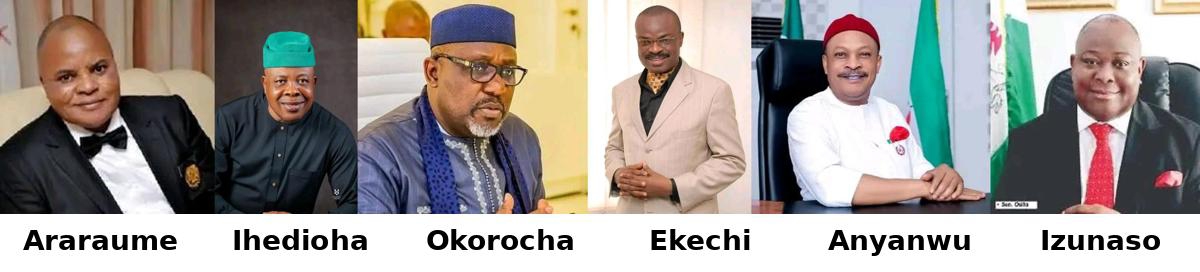
Politics in Imo State has always been a theatre of intense rivalry, strategic alliances, and dramatic power shifts. From the era of Achike Udenwa through the turbulent years of Rochas Okorocha to the current administration of Governor Hope Uzodimma, the struggle for control of the state’s political structure has rarely been quiet. As the countdown to the 2027 governorship election gradually begins, a critical question is emerging in political circles: *have those who once mobilized to stop Rochas Okorocha’s succession plan now gone silent as Governor Hope Uzodimma begins to shape the process of choosing his successor?*

The debate is not merely about personalities. It touches on deeper issues of political fairness, zoning arrangements, power balance among the state’s three senatorial zones, and the role of political actors who previously presented themselves as defenders of democracy.
To understand the emerging political tension around 2027, it is important to revisit what happened toward the end of Rochas Okorocha’s tenure as governor between 2011 and 2019.
Okorocha’s attempt to install his son-in-law, Uche Nwosu, as his successor generated a fierce political backlash across Imo State. Critics accused the governor of trying to create a political dynasty, while opposition politicians, civil society groups, and even members of his own party mobilized to stop the plan.
The resistance came from multiple directions.
Political stakeholders argued that Okorocha’s succession project violated democratic norms and the principle of fairness among the state’s political zones. At the time, many Imo leaders insisted that no individual should single-handedly determine who becomes governor.
The intense political struggle fractured the ruling party structure and produced multiple candidates in the 2019 election. Eventually, the governorship contest produced a complicated outcome in which Emeka Ihedioha of the PDP was initially declared winner. However, the Supreme Court later ruled that votes from 388 polling units had been wrongly excluded and declared Hope Uzodimma of the APC as the lawful winner of the election.
That judgment dramatically altered the political trajectory of the state.
For many observers, the collapse of Okorocha’s succession plan was seen as a victory for political pluralism in Imo. Several actors who resisted that attempt built their reputations as defenders of democratic choice.
Since assuming office in January 2020, Governor Hope Uzodimma has steadily consolidated his influence within Imo’s political structure.
His re-election in the November 2023 governorship election strengthened his position significantly. Uzodimma won the election overwhelmingly, securing victory across all 27 local government areas of the state.
Such a sweeping victory did more than guarantee him a second term. It effectively cemented his authority over the ruling party’s political machinery in the state.
In addition to his dominance at the state level, Uzodimma’s influence within national APC structures has also grown. He currently serves as chairman of the Progressive Governors Forum, the umbrella body of APC governors.
This combination of state and national influence means that the governor enters the succession conversation from a position of enormous political strength.
One of the major political frameworks shaping the 2027 conversation in Imo is the *Imo Charter of Equity*, a political understanding designed to rotate the governorship among the state’s three senatorial zones: Orlu, Okigwe, and Owerri.
Historically, Orlu Zone has dominated the governorship position. Since 1999, it has produced multiple governors, including Achike Udenwa, Rochas Okorocha, and the current governor Hope Uzodimma.
By contrast:
* Okigwe Zone has had only one governor, Ikedi Ohakim (2007–2011).
* Owerri Zone has had only a brief stint in power when Emeka Ihedioha governed for about seven months before the Supreme Court ruling in 2020.
Because of this imbalance, many political stakeholders argue that the next governor in 2027 should come from Owerri Zone as part of a rotation arrangement intended to promote fairness and political stability.
Governor Uzodimma himself has publicly expressed support for this arrangement, stating that the Charter of Equity should guide the emergence of his successor and ensure power shifts away from Orlu Zone.
However, while the charter is widely discussed, critics note that it is not legally binding. In Nigerian politics, such agreements can easily be reshaped by political calculations.
Despite the apparent consensus around zoning, the real contest lies in who will eventually become the preferred candidate of the political establishment.
In many Nigerian states, outgoing governors wield significant influence in determining their successors. Control over party structures, delegates, and campaign resources often allows them to shape the outcome of party primaries.
This reality raises concerns among some political observers in Imo.
They wonder whether the process of choosing the next governor will genuinely reflect open democratic competition or whether it will be carefully orchestrated within the ruling party’s internal power structure.
The fear, in essence, is the possible emergence of a “godfather succession model”similar to what critics accused Okorocha of attempting years ago.
Where Are the Former “Defenders of Democracy”?
Perhaps the most striking aspect of the unfolding political debate is the relative silence of many political actors who once strongly opposed Okorocha’s succession ambitions.
During the 2018–2019 political season, opposition politicians, civil society voices, and sections of the media consistently warned against any attempt by a sitting governor to impose a successor.
Today, however, the political environment appears markedly different.
Many of those voices are either quiet or politically aligned with the current power structure.
Some analysts attribute this silence to shifting political alliances. In Nigerian politics, yesterday’s opponents often become today’s partners.
Others argue that many politicians who once resisted Okorocha’s succession plan have now joined the ruling political establishment and therefore have little incentive to challenge it.
There is also the possibility that the situation is simply too early for open confrontation.
The 2027 election may still appear distant, but political maneuvering has clearly begun behind the scenes.
Although the race has not formally started, discussions about possible successors have already begun within political circles.
Several factors are likely to shape the eventual contest:
If the Charter of Equity is respected, Owerri Zone will produce the next governor.
The ruling APC currently dominates the political landscape in the state, meaning the party’s primary election could effectively determine the next governor.
As the incumbent, Uzodimma is expected to play a significant role in determining who emerges as the APC candidate.
Opposition parties may attempt to build coalitions to challenge the ruling party’s dominance.
Imo politics has repeatedly demonstrated that succession plans rarely go exactly as expected
Okorocha’s failed attempt to install his preferred successor remains a cautionary tale.
What initially appeared to be a well-structured political project eventually collapsed under the weight of party divisions, legal battles, and opposition mobilization.
Similarly, the dramatic Supreme Court decision that brought Uzodimma to power illustrates how unpredictable the state’s political landscape can be.
History suggests that even the most carefully designed succession strategy can unravel unexpectedly.
–
As 2027 approaches, several key questions will determine the direction of Imo politics:
* Will the Charter of Equity truly guide the emergence of the next governor?
* Will political stakeholders insist on an open and competitive process?
* Or will the ruling political structure quietly determine the outcome long before voters go to the polls?
For now, the political arena remains calm on the surface. Yet beneath that calm lies a growing contest for influence, positioning, and strategic advantage.
The unfolding debate over Governor Hope Uzodimma’s eventual successor raises a fundamental question about the consistency of political principles in Imo State.
Years ago, many political actors rallied against what they perceived as Rochas Okorocha’s attempt to impose a successor. Their resistance helped reshape the political landscape and contributed to the dramatic events that eventually produced the current administration.
Today, however, as the process of succession politics gradually begins again, the once-loud voices of opposition appear noticeably quieter.
Whether this silence reflects political pragmatism, strategic patience, or simple acceptance of the realities of power remains to be seen.
What is clear is that the struggle for Imo’s political future has already begun—even if it is still unfolding behind closed doors.
The coming months and years will reveal whether the defenders of democratic choice in the past will rise again to demand transparency, or whether the politics of succession in Imo will once more be decided by the calculations of those who currently hold power.
And as that drama unfolds, the central question will continue to echo across the state’s political landscape:
*Have those who stopped Okorocha truly gone to sleep—or are they simply waiting for the right moment to act again?*
Written By: Jotham Emenyonu (08034223515).